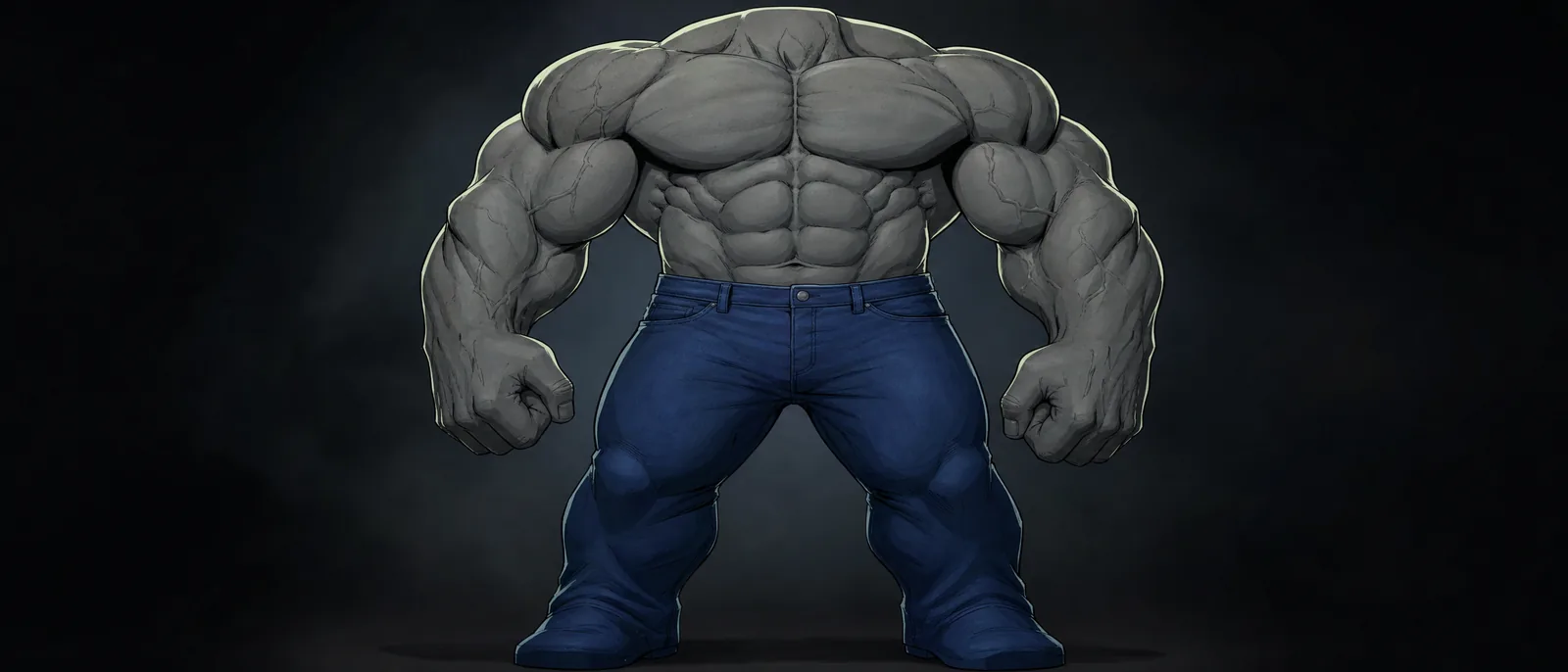
Bruce Banner is 5'9" and about 128 pounds. The Hulk is eight feet tall and somewhere past 1,400. The whole thing takes four seconds.
Somewhere on the internet right now, someone is arguing this is a peptide protocol.
It's a stupid question and I want to take it completely seriously, because working out exactly how wrong it is turns out to be the fastest way to understand what these compounds actually do — and, more importantly, the enormous gap between what people say they do and what anyone has bothered to check.
Everything below is a research compound. Most aren't approved for people, several are banned in sport, and there are no doses or protocols in this article. This is a thought experiment about a cartoon character. Act accordingly.
The part no drug is getting past
Banner picks up 1,270 pounds in four seconds. Before we talk about what a peptide could contribute, let's size the hole.
Where's the mass coming from? Matter doesn't show up on request. Air weighs about 1.2 kg per cubic meter, which means a normal 12-by-12 bedroom holds maybe 86 pounds of the stuff. To build the Hulk out of his surroundings, Banner has to inhale roughly fifteen rooms of air, instantly, through a windpipe the width of a garden hose. Everyone else in the building suffocates. The Hulk's first act is manslaughter by inhalation.
What's it cost? Building a pound of lean tissue runs somewhere around 2,500 calories once you count everything. Times 1,270 pounds, that's 3.2 million calories in four seconds — about 3.3 gigawatts. Three nuclear reactors. Or, if you grew up in the eighties, 2.7 DeLoreans.
And then he cooks. Bodies are maybe 25% efficient at this. The other 75% is heat, and dumping that much heat into a 635-kilo body in four seconds raises his core temperature by something like 4,500 degrees. Iron melts at 1,811. Banner doesn't turn green. Banner turns into a smell.
Hold onto that number: 576 kilograms. That's the target. Everything below gets measured against it.
Okay, the actual stack
The growth hormone stuff
This is where the mythology lives, and the logic isn't crazy. More GH means more IGF-1, more IGF-1 means satellite cells wake up and start donating nuclei to your muscle fibers. That chain is real. It's in the textbooks. Nobody disputes it.
CJC-1295 and ipamorelin are the pairing you'll see named in every second Reddit thread, usually together, because they hit the GH release button through two different doors. Go read those threads and the reports are pretty uniform: better sleep, softer joints, looking a bit fuller in the mirror after a few weeks. What you almost never see is someone claiming a big strength jump — which is interesting, because that's what everyone expected going in.
There's a reason for that, and it comes from the one place this has actually been measured properly. Growth hormone itself has been studied to death in healthy young adults, and when somebody finally pooled all the decent trials, the answer was about two kilos of "lean mass" — a big chunk of it water — and no strength improvement at all. People got puffier. They didn't get stronger. What they did get was more swelling and more fatigue than the placebo group.
Two kilos. Banner needs 576.
Tesamorelin is the one I'd point at if you only look at one thing in this whole article. It's the GHRH analog that actually made it through the FDA — a real approved drug, on the market. And what's it approved for? Reducing belly fat in a specific condition. Not muscle. Not strength. When this class got held to a proper evidentiary standard, what survived was a fat-distribution drug. That's not nothing, but it's not what the forums are selling.
MK-677 isn't technically a peptide — it's an oral compound that mimics ghrelin — but it gets lumped in because it does exactly what the theory wants: raises GH and IGF-1, and keeps them up. Two-year study in older adults. Result: about a kilo of fat-free mass, no meaningful strength or function improvement, plus a serious appetite increase and worse blood sugar. Users will tell you the hunger part is not exaggerated. Merck looked at the whole picture and shelved it.
Hexarelin hits harder than ipamorelin, and it's the clearest illustration of why "just push the axis harder" isn't a plan. Receptors desensitize fast, and it drags cortisol and prolactin up with it. More lever, same ceiling, extra problems.
2–3 kg heavier, much of it water. Holding fluid, hungrier, worse glucose. No stronger.
Taking the brake off
Here's the actual Hulk lever, and it's got nothing to do with growth signals. It's about removing a limit.
Myostatin is your body's brake pedal on muscle growth. Break it and the results are genuinely ridiculous. Belgian Blue cattle have a myostatin mutation and are so absurdly over-muscled the trait has a name — double muscling. They look computer-generated. Whippets carrying two copies look like someone inflated a greyhound with a bike pump. And there's a documented case of a child born with the mutation who had visible, adult-grade muscle definition as a toddler.
That is the real Hulk gene. It exists. It walks around.
So: what if you just block myostatin in a grown adult on purpose? People tried. Twice, seriously.
ACE-031 was built to soak up myostatin, and in muscular dystrophy trials it did add lean mass — it worked. They stopped development anyway, because participants started getting nosebleeds and spider veins. Turns out that signaling pathway wasn't only managing muscle. It was also quietly holding your blood vessels together. Take the brake off muscle, take it off some other things too.
Bimagrumab is the one that really should have ended the argument. It works. It genuinely, reliably adds lean mass and strips fat — in one trial people gained muscle and lost roughly a fifth of their body fat, which is a result most drugs would kill for.
And then they tested it in a muscle-wasting disease and it missed the endpoint that mattered. Patients had more muscle. They couldn't walk any further.
Bigger and stronger are two different outcomes, and the drugs that are good at the first keep failing at the second.
Muscle you can measure on a scan isn't automatically muscle that does anything. Tendon stiffness, contractile quality, how well your nervous system can actually recruit the thing — none of that comes free with size.
Bigger, leaner, possibly no more useful. Now with fragile capillaries.
IGF-1 LR3
Modified IGF-1, engineered to dodge the proteins that normally keep it in check — meaning it stays switched on longer than your body intends.
Forum consensus on this one is unusually cautious, which is its own kind of signal. And there's basically no human performance data at all. What we do know is the mechanism's price: a sustained growth signal doesn't check which tissue it's growing, and it'll drop your blood sugar while it works. When a compound this old still has no human trials behind it, that's not an oversight anyone forgot about.
The energy peptides
Fine — if mass is capped by physics, maybe the Hulk's power output is the peptide-shaped part of this. Short section, because the answer is short.
MOTS-c is honestly one of the coolest molecules in here. It's a peptide coded in your mitochondrial DNA, not your nuclear DNA, which is not where anybody expected to find a signaling peptide. In mice it improves insulin sensitivity and makes them physically better, including old mice. In humans, for performance, there's essentially nothing. It's a real discovery sitting at a very early stage, and "amazing in mice" is where the large majority of pharmacology goes to die.
SS-31 is further along — it targets the inner mitochondrial membrane to make energy production more efficient, and it's been through serious clinical trials. It got all the way to phase 3 in patients whose mitochondria are genuinely broken, the people with the most to gain from it, and it missed.
If it can't get that group walking further, be realistic about what it's doing for a healthy person's energy levels.
He needs 3.3 gigawatts. Mitochondrial efficiency gains are single-digit percentages, on the days they show up.
The repair ones
The Hulk eats artillery fire, so recovery compounds belong in any serious version of this.
BPC-157 is the one everyone's cousin is on. Search it on any lifting forum and you'll find a hundred versions of the same story: guy tears something, guy is told surgery or six months off, guy runs BPC, guy is back under the bar in five weeks and will not shut up about it.
The stories are strikingly consistent — which is either a signal that something real is going on, or a signal that people who feel better post about it and people who don't quietly stop posting. That's true of every compound ever sold, which is exactly what makes this hard.
Underneath the stories: BPC-157 is a fragment of a protein found in gastric juice, and in rats it looks genuinely impressive for tendon, ligament and gut healing. That rodent work is real and there's a lot of it. The catch is that most of it traces back to essentially one research group, and in twenty years nobody has run the human trial that would settle the argument.
Thousands of guys who swear by it, zero randomized humans. "Everyone says it works" and "anyone checked" are completely different sentences, and the internet treats them as the same one.
TB-500 is the stablemate, related to a protein that helps cells migrate and build new blood vessels. The parent compound has been through human trials — for dry eye, for heart repair — and none of them were about athletes, and none of them were dramatic. Plausible mechanism, reputation way out ahead of the evidence. Both of these have been banned in sport since the early 2020s, which tells you people in sport believe they do something.
Adding it all up
Give every compound its best possible day. Assume nothing interferes with anything. Assume Banner is a perfect responder who wins every genetic coin flip.
| Tier | Compounds | Best case | Toward 576 kg |
|---|---|---|---|
| GH axis | CJC-1295, ipamorelin, tesamorelin, MK-677, hexarelin | ~2 kg, mostly water, no strength gain | 0.35% |
| Myostatin | ACE-031, bimagrumab | Real size, failed the function test, vascular problems | 0.60% |
| IGF-1 | IGF-1 LR3 | No human data, real risks | — |
| Energy | MOTS-c, SS-31 | Mouse data; phase 3 miss | ~0% |
| Repair | BPC-157, TB-500 | Rat data, forum legend, no human RCTs | ~0% |
TOTAL — four to six kilos, a lot of it water, probably not stronger, with a real side-effect bill.
Banner needed 576 kilos in four seconds. The most aggressive honest read of every compound in here gets him about one percent of the way, over a period of months, and the actual trial data says he wouldn't be able to lift any more at the end of it than he could at the start.
Two things in this article are completely real
The myostatin thing. Not a vial — a birth certificate. The Belgian Blues, the inflated whippets, the kid with the mutation. Those are all real and they're all congenital. Twenty years of trying to reproduce it in adults produced two drugs that made people bigger and one very clear lesson about why that brake is there in the first place.
Hysterical strength. Banner's anger trigger is the single Hulk mechanism that genuinely happens. Under a big enough adrenaline surge, your pain and fatigue signals get suppressed and your nervous system lets go of the safety limiter that normally stops you from firing every motor unit at once. You get a few seconds of access to a reserve your body deliberately keeps locked — because spending it tends to tear things off the bone.
Nobody gains a gram. Nobody turns green. It's the least cinematic item on the whole list and it's the only one that's real.
So: was the Hulk on peptides?
No. The Hulk was on three nuclear reactors and a repealed law of conservation of mass.
But do this exercise honestly and you end up somewhere more useful than a punchline.
The same pattern shows up in every single tier above, and it isn't "none of this works." It's that the compounds with the most exciting mechanisms have the thinnest human evidence, and the ones that got tested properly kept delivering size without function. Two kilos of water weight. More muscle, same walking distance. A phase 3 miss in the exact group that needed it.
Which points at the thing that actually matters here, and it's not dosing or stacking or any of the stuff the forums argue about at 2am.
When the real effects are this small, the margin for error in the vial goes to zero. Something that's 80% pure, or that's actually a closely related peptide off by a single swap, doesn't give you a slightly weaker result. It gives you a meaningless one — and a meaningless result looks exactly like a real one. Same numbers. Same confidence. No way to tell from the inside.
The Hulk is impossible because of thermodynamics. That's fine, he's a comic book.
Bad data is the harder problem, because it doesn't look like a problem.